Introduction
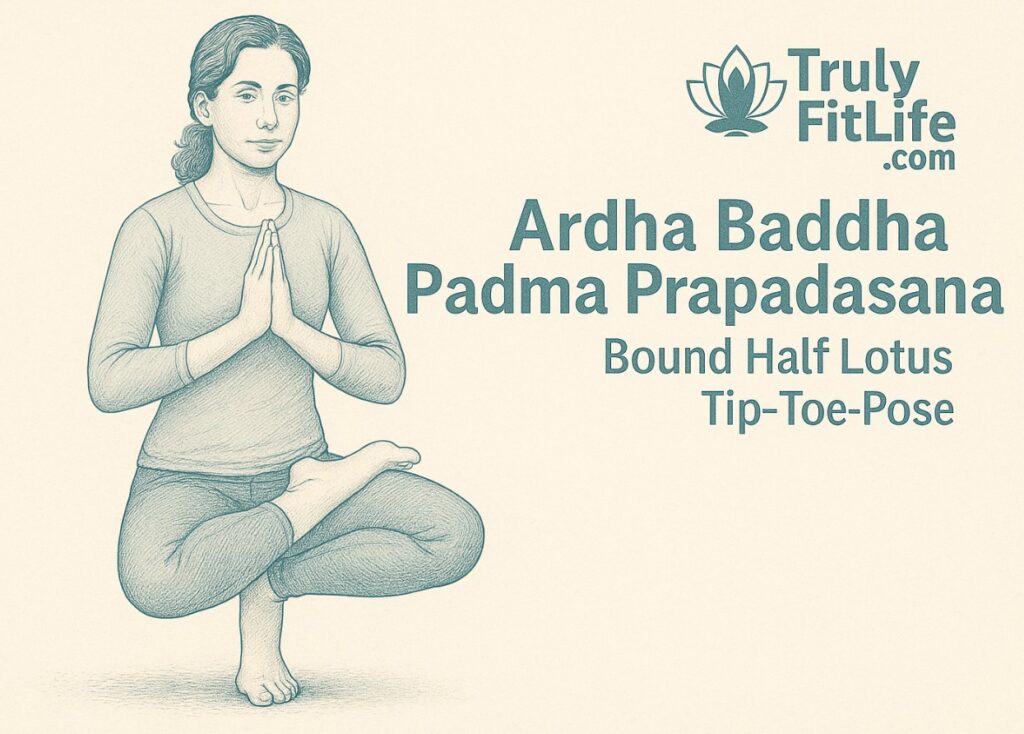
Ardha Baddha Padma Prapadasana, translated as the Bound Half Lotus Tip-Toe Pose, is a rare and traditional yoga posture that combines the grounding effect of Half Lotus (Ardha Padmasana) with the stability challenge of balancing on the toes of one foot. This posture is deeply rooted in classical yoga practices and is often seen as both a balancing and a hip-opening asana.
Unlike simple balancing poses such as Tree Pose (Vrikshasana), this posture requires significant hip mobility, ankle strength, and mental focus. It challenges practitioners to find stillness while balancing on the ball of the foot, symbolizing the yogic principle of harmony between stability and surrender.
Step-by-Step Instructions
- Start in Tadasana (Mountain Pose):
Stand tall with feet together, arms by your sides, and spine elongated. - Shift weight onto one leg:
Ground through the left foot and activate the thigh muscles for stability. - Form Half Lotus:
Bend the right knee, lift the leg, and place the right foot on top of the left thigh with the sole facing upward. Adjust the heel close to the lower abdomen. - Bring palms together:
Place hands in Anjali Mudra (prayer gesture) at the chest or bind one arm around the back to hold the lotus foot (advanced bind). - Exhale and bend standing leg:
Slowly bend the supporting leg, lowering into a half squat. Keep the torso upright and spine erect. - Rise onto tiptoe:
Gradually lift the heel of the supporting foot so that you balance only on the ball of the foot. - Find your drishti:
Fix your gaze at a steady point in front of you to improve concentration and balance. - Breath awareness:
Hold the pose for 15–30 seconds while breathing slowly and steadily. Advanced practitioners may hold for up to one minute. - Release with control:
Inhale, straighten the standing leg, lower the heel, and release the lotus leg back to Tadasana. Repeat on the opposite side.
Alignment Tips
- Ensure the lotus foot is firmly placed on the thigh without forcing the knee.
- Keep the chest lifted and shoulders relaxed.
- Engage the core muscles to stabilize the body.
- Use a wall for initial practice if balance feels unsteady.
Health Benefits of Ardha Baddha Padma Prapadasana
Physical Benefits
- Strengthens the lower body: Builds ankle stability, calf strength, and thigh endurance.
- Improves hip flexibility: The lotus placement gently opens the hips.
- Enhances spinal alignment: Maintaining an upright torso strengthens back muscles.
- Boosts digestion: The squat-like movement massages abdominal organs.
- Increases proprioception: Enhances body awareness and coordination.
Mental & Emotional Benefits
- Sharpens concentration: Requires steady focus to maintain balance.
- Cultivates patience: Teaches control and calmness under physical challenge.
- Promotes grounding: Balancing on one foot strengthens the sense of stability.
- Encourages discipline: Ideal for deepening a meditative mindset during asana practice.
Contraindications & Safety Precautions
- Avoid if you have severe knee, ankle, or hip injuries.
- Not suitable for practitioners with balance disorders, vertigo, or dizziness.
- Pregnant women should avoid this posture due to abdominal compression.
- Do not force the lotus leg if hips are tight; practice hip openers first.
Modifications & Variations
- Beginner modification: Practice Half Lotus while standing on a flat foot without tiptoe.
- Supportive variation: Use a wall or chair for balance while rising onto tiptoe.
- Advanced variation: Bind one arm behind the back to hold the lotus foot while balancing.
- Gentle option: Place the lotus foot lower (near the calf) instead of high on the thigh.
Muscle Groups Engaged
- Quadriceps (supporting thigh)
- Calves and ankles (for tiptoe balance)
- Hip flexors and abductors (lotus leg)
- Gluteus medius and maximus (for pelvic stability)
- Core muscles (for upright alignment)
Chakra Activation
- Root Chakra (Muladhara): Provides stability through balance.
- Sacral Chakra (Svadhisthana): Opens the hips for energy flow.
- Crown Chakra (Sahasrara): Encourages meditative awareness and focus.
Drishti (Gaze Point)
- Forward gaze for beginners to maintain stability.
- Nasagra Drishti (tip of the nose) for advanced concentration.
Preparatory Poses
- Ardha Padmasana (Half Lotus Pose)
- Vrikshasana (Tree Pose)
- Malasana (Garland Pose)
- Tadasana (Mountain Pose)
Counter Poses
- Uttanasana (Standing Forward Bend)
- Balasana (Child’s Pose)
- Sukhasana (Easy Pose)