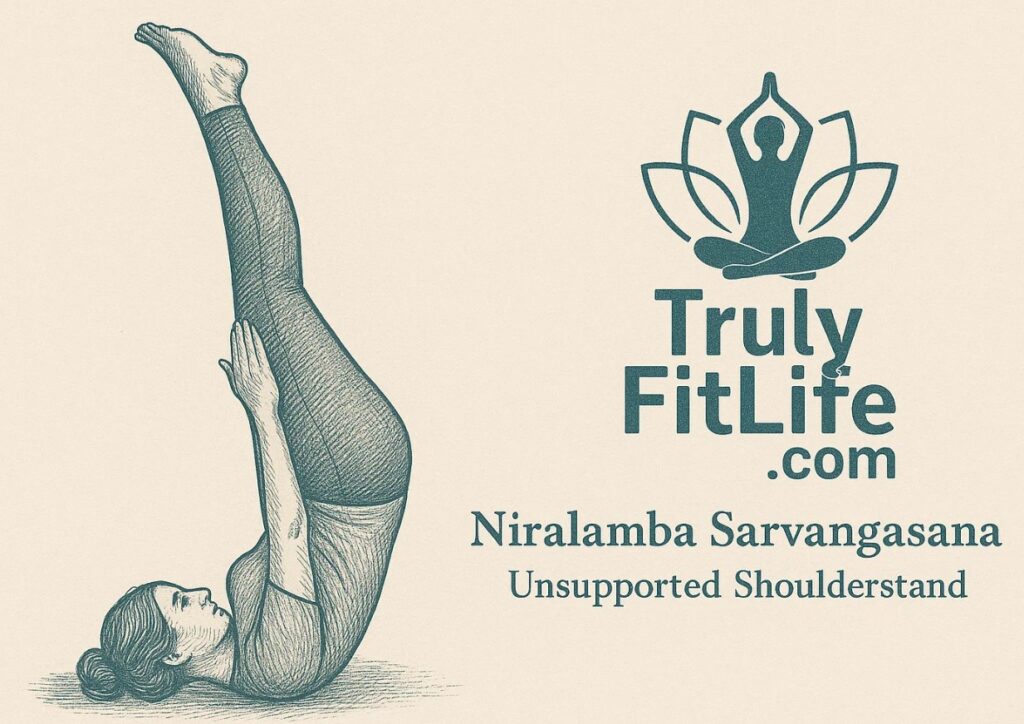
Niralamba Sarvangasana – Unsupported Shoulderstand is an advanced yoga inversion that demands strength, balance, and control. Unlike the traditional Sarvangasana (Shoulderstand), in this variation, the practitioner removes the support of the hands, balancing the body vertically while engaging the core, shoulders, and legs. This asana is both a test of endurance and a pathway to inner stillness, making it a revered posture in traditional Hatha Yoga and modern yoga practice.
In this article, we will dive into the step-by-step guide, benefits, contraindications, variations, and practical insights on mastering Niralamba Sarvangasana – Unsupported Shoulderstand.
🧾 Table of Contents
- Meaning and Origins of Niralamba Sarvangasana
- How to Practice Niralamba Sarvangasana – Step by Step Guide
- Breathing and Drishti in Niralamba Sarvangasana
- Health Benefits of Niralamba Sarvangasana – Unsupported Shoulderstand
- Muscles and Body Systems Activated
- Safety Guidelines and Contraindications
- Preparatory Poses
- Follow-up Poses
- Modifications and Variations
- Common Mistakes to Avoid
- Spiritual and Energetic Aspects
- Final Thoughts
Meaning and Origins of Niralamba Sarvangasana
The term Niralamba comes from Sanskrit:
- Nir = without
- Alamba = support
- Sarvangasana = the all-limbs posture or Shoulderstand
Thus, Niralamba Sarvangasana – Unsupported Shoulderstand literally means “Shoulderstand without support.”
This asana symbolizes self-reliance and inner balance. While traditional Sarvangasana uses the hands as a base to hold the torso, in this posture, the yogi lifts the arms away from the back, creating a challenging yet liberating inversion.
Classical yoga texts, such as the Hatha Yoga Pradipika and Gheranda Samhita, emphasize the value of inversions for improving circulation, stimulating energy centers, and balancing the endocrine system. Advanced yogis practice this pose to refine concentration (dharana) and energy flow (prana).
How to Practice Niralamba Sarvangasana – Step by Step Guide
Step 1: Preparation
- Begin in Sarvangasana (Supported Shoulderstand) by lying flat on your back.
- Lift your legs over your head, supporting your lower back with your hands.
- Ensure your torso is vertical, chin tucked toward your chest.
Step 2: Alignment
- Shift weight evenly on your shoulders, not on the neck.
- Keep elbows firm on the floor.
Step 3: Transition
- Slowly release your hands from your lower back.
- Stretch them upward toward the ceiling or keep them extended alongside your thighs.
- Engage your core and legs to maintain balance.
Step 4: Hold the Pose
- Maintain steady breathing.
- Stay for 15–45 seconds initially, increasing with practice to 2–3 minutes.
Step 5: Releasing
- Bring hands back to the lower back for support.
- Slowly roll down vertebra by vertebra, lowering legs to the floor.
- Rest in Shavasana for recovery.
Breathing and Drishti in Niralamba Sarvangasana
- Breathing: Keep breath slow, rhythmic, and deep. Inhale while lengthening upward, exhale while stabilizing.
- Drishti (Gaze Point): Focus on the chest or tip of the nose (Nasagra Drishti).
Health Benefits of Niralamba Sarvangasana – Unsupported Shoulderstand
- Improves Circulation – Encourages venous return, revitalizing the heart and brain.
- Strengthens Core and Shoulders – Builds stability and power in upper and middle body.
- Balances Hormones – Stimulates thyroid and parathyroid glands.
- Boosts Concentration – Requires mindfulness and mental clarity.
- Enhances Respiratory Health – Expands chest capacity.
- Calms the Nervous System – Encourages parasympathetic dominance.
- Improves Posture – Aligns spine and corrects slouching.
Muscles and Body Systems Activated
- Muscles: Deltoids, trapezius, triceps, abdominals, spinal erectors, glutes, hamstrings, quadriceps.
- Systems: Endocrine, nervous, respiratory, circulatory, and lymphatic systems.
Safety Guidelines and Contraindications
Avoid practicing if you have:
- Hypertension or cardiac conditions
- Cervical spine issues
- Glaucoma or ear problems
- Pregnancy (unless under expert supervision)
- Recent surgery
👉 Always practice under guidance before attempting unsupported inversions.
Preparatory Poses
- Sarvangasana (Shoulderstand)
- Halasana (Plow Pose)
- Viparita Karani (Legs Up the Wall Pose)
- Setu Bandhasana (Bridge Pose)
Follow-up Poses
- Matsyasana (Fish Pose)
- Balasana (Child’s Pose)
- Shavasana (Corpse Pose)
Modifications and Variations
- Beginner Variation: Keep one hand supporting the lower back while extending the other arm.
- Intermediate Variation: Keep arms extended parallel on the floor.
- Advanced Variation: Perform full unsupported balance with arms stretched overhead or folded in Namaskar Mudra.
Common Mistakes to Avoid
- Overstraining the neck
- Arching the lower back excessively
- Losing breath awareness
- Rushing into the pose without warm-up
Spiritual and Energetic Aspects
- Activates the Vishuddha (Throat Chakra) – linked to communication and truth.
- Stimulates the Ajna (Third Eye Chakra) – enhances intuition and focus.
- Encourages surrender and inward awareness.
Final Thoughts
Niralamba Sarvangasana – Unsupported Shoulderstand is a pinnacle posture of yoga, combining strength, stability, and mindfulness. For seasoned practitioners, it offers an opportunity to refine both body and mind while deepening one’s meditation practice. Approach it with patience, respect, and awareness to gain its full benefits.
🧘 Related Yoga Poses You May Like
- ➤ Sarvangasana – Shoulderstand Pose Complete Yoga Guide for Balance & Vitality
- ➤ Sirsasana – Headstand Pose Complete Guide
- ➤ Halasana – Plow Pose: Steps, Benefits, and Complete Yoga Guide
- ➤ Viparita Karani – Legs Up the Wall Pose Complete Guide
- ➤ Karnapidasana – Knee Ear Pose Complete Yoga Guide for Relaxation & Flexibility
- ➤ Handstand – Adho Mukha Vrksasana: Master the Powerful Yoga Inversion