📑 Table of Contents
- Introduction to Ardha Chakrasana – Half Wheel Pose
- Step-by-Step Guide to Practice
- Benefits of Ardha Chakrasana – Half Wheel Pose
- Physical Benefits
- Mental & Emotional Benefits
- Spiritual Benefits
- Muscles and Body Systems Involved
- Drishti (Gaze Point) and Breathing Pattern
- Preparatory and Counter Poses
- Modifications and Variations
- Common Mistakes and Safety Tips
- Contraindications – Who Should Avoid This Pose?
- Therapeutic Applications
- Ardha Chakrasana in Yoga Styles
- Final Thoughts
1. Introduction to Ardha Chakrasana – Half Wheel Pose
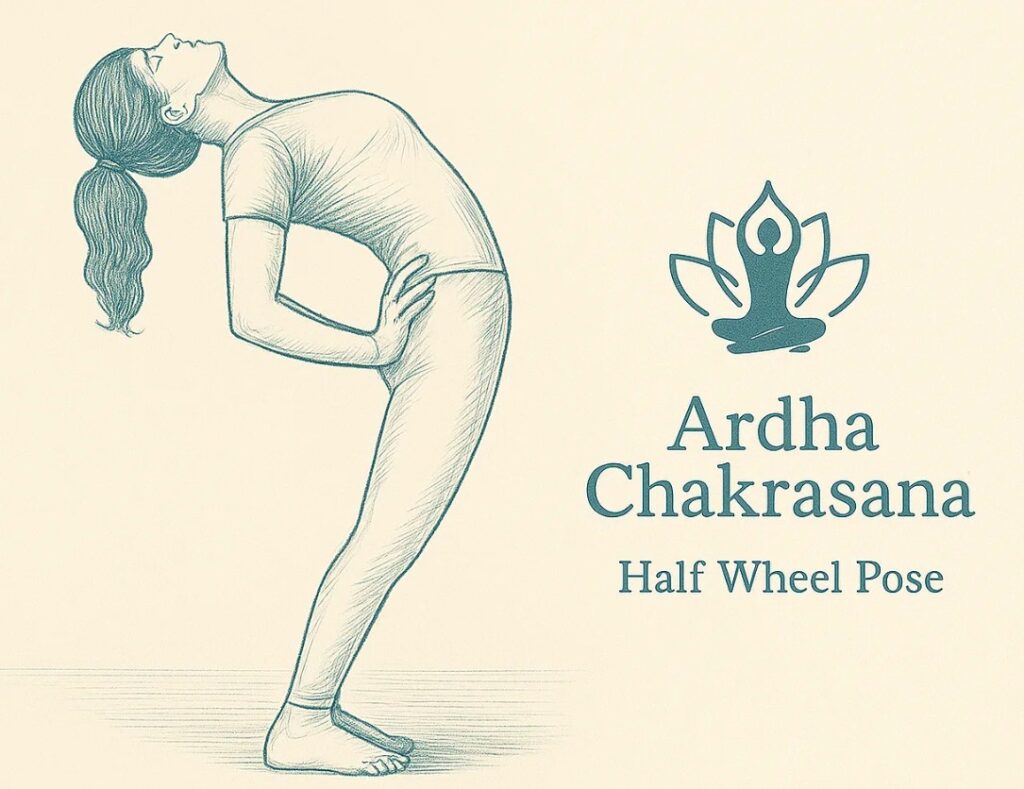
Ardha Chakrasana – Half Wheel Pose is a gentle standing backbend that focuses on thoracic (mid-spine) extension and chest opening. It’s often used in warmups, posture routines, and yoga sequences as a bridge between basic standing poses and deeper backbends. The pose helps counteract the forward-rounded posture common from prolonged sitting and device use.
2. Step-by-Step Guide to Practice
How to perform Ardha Chakrasana – Half Wheel Pose
- Begin in Tadasana (Mountain Pose) with feet hip-width apart and weight evenly balanced.
- Inhale and sweep the arms overhead, keeping the shoulders relaxed and the palms facing each other.
- Slightly micro-bend the knees to protect the lower back; draw the tailbone gently down.
- Exhale, engage the core lightly, and begin the backbend by lifting the chest up and back — lead the movement from the thoracic spine rather than forcing the lumbar (lower) spine.
- If comfortable, slide the hands to the lower back with fingers pointing down to support the sacrum; use the hands as a light lever to lift the chest.
- Hold for 3–6 breaths initially; with practice you can increase the hold as mobility improves. Keep breathing steady.
- To come out, inhale and lift through the front body, pressing the hands to the thighs (if used), and return to upright on an exhale.
3. Benefits of Ardha Chakrasana – Half Wheel Pose
Ardha Chakrasana offers a combination of physical and mental benefits. Done mindfully, it strengthens the back, opens the chest for better respiration, and prepares the body for deeper heart-openers.
4. Physical Benefits
- Improves thoracic mobility and shoulder range of motion.
- Strengthens spinal extensors and scapular stabilizers.
- Helps open the chest, which can increase lung capacity and improve breathing mechanics.
- Corrects postural imbalances from prolonged sitting.
5. Mental & Emotional Benefits
- Releases tension accumulated in the upper back and shoulders.
- Promotes alertness and a feeling of expansion — useful mid-day to counteract fatigue.
- Encourages confidence through an open chest and upright posture.
6. Spiritual Benefits
- Functions as a gentle heart-opener, encouraging a receptive, centered state in preparatory sequences for meditation and pranayama.
- Can support energetic balance between the heart and throat regions when practiced with mindful breath.
7. Muscles and Body Systems Involved
Primary muscles: erector spinae (spinal extensors), lower trapezius, rhomboids, and the posterior shoulder stabilizers. Secondary involvement: gluteus group (for stability) and hip flexors (which slightly lengthen). Systems influenced include respiratory and autonomic nervous system via improved chest expansion.
8. Drishti (Gaze Point) and Breathing Pattern
- Drishti: Soft upward gaze or horizon level — avoid forcing the neck into extension if you have cervical sensitivity.
- Breathing: Inhale to lift and expand the chest; exhale to settle and soften. Maintain steady diaphragmatic breathing throughout.
9. Preparatory and Counter Poses
Preparatory Poses: Tadasana (Mountain Pose), Bhujangasana (Cobra), shoulder circles, wall thoracic extensions.
Counter Poses: Paschimottanasana (Seated Forward Bend), Balasana (Child’s Pose) — these help release the lower back and rebalance the spine.
10. Modifications and Variations
- Hands on sacrum: Place palms on the lower back for support and gentle leverage.
- Wall-assisted variation: Stand 6–8 inches from a wall and press the palms to the wall behind you to control the depth of the bend.
- Supported with blocks: Use a block behind the sacrum or lean hands on blocks for a gentler approach.
- Revolved or lateral option: Add a small side bend to target thoracic rotation and lateral mobility.
11. Common Mistakes and Safety Tips
- Collapsing the lumbar spine: Focus on lifting through the thoracic spine and engaging the core to protect the lower back.
- Pushing the ribs forward: Keep ribs drawing gently toward the spine to avoid over-arching.
- Tensing the neck: Maintain a neutral neck; look up only if it’s comfortable.
- Forcing range: Work within pain-free limits and use props to manage intensity.
12. Contraindications – Who Should Avoid This Pose?
Avoid or modify Ardha Chakrasana if you have: recent lumbar disc herniation, severe lower-back pain, uncontrolled high blood pressure, or certain cervical spine issues. Pregnant practitioners should use wall/support variations and avoid deep lumbar compression. Always consult a clinician for pre-existing spine conditions.
13. Therapeutic Applications
This pose is useful in routines aimed at improving posture, relieving upper-back stiffness from desk work, and preparing for deeper backbends. With guidance, it can be part of rehabilitation or mobility protocols to restore thoracic extension and shoulder health.
14. Ardha Chakrasana in Yoga Styles
- Hatha & Vinyasa: Serves as a transitional backbend and warmup.
- Iyengar: Emphasizes alignment and often uses props for safe engagement.
- Restorative: Performed with bolsters/blocks for a supported chest-opening variation.
15. Final Thoughts
When practiced mindfully and progressively, Ardha Chakrasana – Half Wheel Pose builds spinal resilience and improves chest openness without placing undue stress on the lower back. Prioritize thoracic lift, use props as needed, and integrate the pose into a balanced sequence for best results.
🧘 Related Yoga Poses You May Like
- ➤ Setu Bandhasana – Bridge Pose: Steps, Benefits, and Complete Yoga Guide
- ➤ Dhanurasana – Bow Pose
- ➤ Urdhva Hastasana (Upward Salute Pose) – Steps, Benefits, and More
- ➤ Standing Crescent Pose (Indudalasana)
- ➤ Bhujangasana (If Exists Skip Else Ignore)
- ➤ Chaturanga Dandasana – Four Limbed Staff Pose (Complete Guide)