Table of Contents
- Introduction — What is Alternate Nostril Breathing (Nadi Shodhana)?
- Origins and Yogic Background of Alternate Nostril Breathing (Nadi Shodhana)
- Science & Physiology: How Alternate Nostril Breathing (Nadi Shodhana) Works
- Step-by-Step Practice: Alternate Nostril Breathing (Nadi Shodhana) Technique (Beginner)
- Best Time, Duration & Frequency for Alternate Nostril Breathing (Nadi Shodhana)
- Benefits of Alternate Nostril Breathing (Nadi Shodhana)
- Common Mistakes & Troubleshooting While Practicing Alternate Nostril Breathing (Nadi Shodhana)
- Variations and Advanced Practices of Alternate Nostril Breathing (Nadi Shodhana)
- Who Should Avoid or Modify Alternate Nostril Breathing (Nadi Shodhana)?
- Safety Tips, Integration with Meditation & Final Notes
1. Introduction — What is Alternate Nostril Breathing (Nadi Shodhana)?
Alternate Nostril Breathing (Nadi Shodhana) is a classic pranayama technique from the yogic tradition. The practice involves breathing in and out through alternate nostrils using a specific finger lock (Vishnu mudra) to gently close one nostril at a time. The method is simple yet profoundly effective for calming the nervous system, balancing the mind, and preparing for meditation.
2. Origins and Yogic Background of Alternate Nostril Breathing (Nadi Shodhana)
Alternate Nostril Breathing (Nadi Shodhana) originates in classical Hatha Yoga and is described in many pranayama manuals. The Sanskrit name means “purification of the nadis” — the subtle energy channels (primarily ida and pingala). Traditional teachers use this pranayama to harmonize subtle energy flow and ready the practitioner for deeper meditative states.
3. Science & Physiology: How Alternate Nostril Breathing (Nadi Shodhana) Works
Modern research suggests Alternate Nostril Breathing (Nadi Shodhana) affects the autonomic nervous system. Slow, regulated nasal breathing increases parasympathetic activity (rest-and-digest), lowers heart rate, and can reduce cortisol levels. Studies also show improved heart-rate variability and enhanced cognitive focus after regular practice.
4. Step-by-Step Practice: Alternate Nostril Breathing (Nadi Shodhana) Technique (Beginner)
Follow these steps carefully:
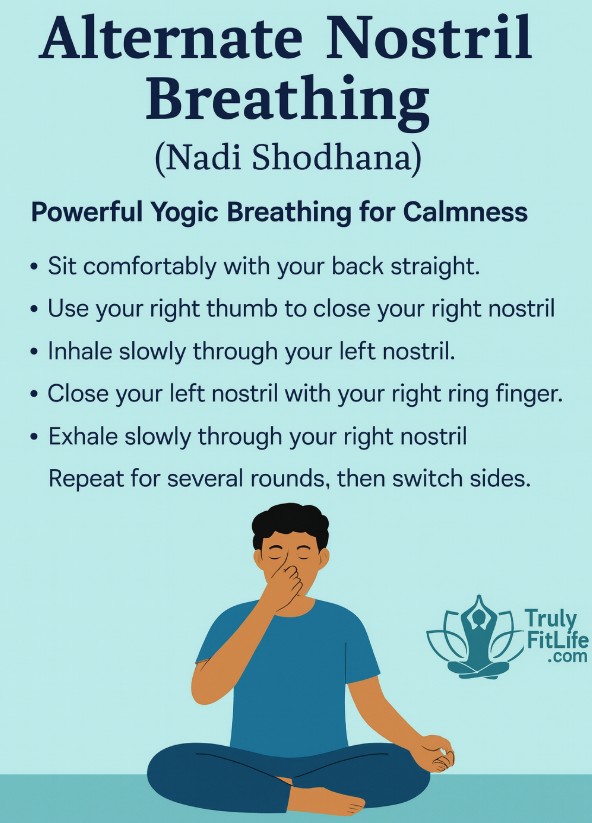
- Sit comfortably with an erect spine — cross-legged, on a chair, or kneeling. Relax shoulders and jaw.
- Form Vishnu Mudra with your right hand: fold the index and middle fingers into the palm; use the thumb to close the right nostril and the ring finger (or little finger) to close the left nostril.
- Soften your gaze or close your eyes. Breathe naturally for a few cycles.
- Close the right nostril with your right thumb. Inhale slowly and gently through the left nostril to a comfortable count (e.g., 4 counts).
- Close the left nostril with your ring finger, release the right nostril, and exhale smoothly through the right nostril (count 6).
- Inhale through the right nostril (same comfortable count).
- Close the right nostril, release the left, and exhale through the left nostril.
- This completes one round. Start with 5–10 rounds (5–10 minutes). Gradually extend to 15 minutes as you become comfortable.
Notes: Keep breath smooth — avoid force, strain, or breath retention as a beginner.
5. Best Time, Duration & Frequency for Alternate Nostril Breathing (Nadi Shodhana)
- Best time: Morning (to set the day), before meditation, or in the evening to unwind.
- Duration: 5–20 minutes per session. Beginners: 5–10 minutes daily.
- Frequency: Daily practice is ideal; at minimum 3–4 times per week for noticeable effects.
6. Benefits of Alternate Nostril Breathing (Nadi Shodhana)
Alternate Nostril Breathing (Nadi Shodhana) offers a wide range of benefits:
- Calms the nervous system: reduces stress, anxiety, and helps manage panic symptoms.
- Balances hemispheres: may improve mental clarity by harmonizing left/right brain activity.
- Improves respiratory function: trains slow, efficient nasal breathing.
- Enhances focus and concentration: useful before study, work, or meditation.
- Supports sleep and relaxation: practice in the evening helps prepare the mind for rest.
- Regulates mood: reduces agitation and promotes emotional steadiness.
7. Common Mistakes & Troubleshooting While Practicing Alternate Nostril Breathing (Nadi Shodhana)
- Breathing too quickly: Keep the breath slow and controlled.
- Forcing breaths: Avoid effortful inhalation or exhalation — keep it gentle.
- Tensing the face or body: Relax jaw, eyes, shoulders.
- Poor finger placement: Use thumb and ring finger gently; don’t press hard into the nostrils.
- Overextending duration prematurely: Build time gradually to avoid dizziness.
If you feel lightheaded, stop, breathe normally, and rest.
8. Variations and Advanced Practices of Alternate Nostril Breathing (Nadi Shodhana)
- Anulom Vilom (without retention): Simple alternate breathing without kumbhaka (retention). Good for beginners.
- Nadi Shodhana with kumbhaka: Add gentle breath retention after inhalation or exhalation — only under guidance.
- Counts & ratios: Beginners 1:1 (inhale:exhale). Advanced practitioners often use ratios like 1:2 or include holds (e.g., 4:4:8).
- Guided combo: Combine with visualization or chakra focus for deeper energetic work.
Always progress slowly — advanced techniques are best learned with an experienced teacher.
9. Who Should Avoid or Modify Alternate Nostril Breathing (Nadi Shodhana)?
- People with severe nasal blockages (temporary congestion) may modify or avoid until cleared.
- Those with serious cardiovascular conditions or uncontrolled hypertension should consult a physician before starting.
- Pregnant women may practice a gentle version but should consult their health provider.
- If you feel intense discomfort, dizziness, or panic, stop and resume normal breathing.
10. Safety Tips, Integration with Meditation & Final Notes
- Practice on an empty or light stomach for comfort.
- Keep posture upright to facilitate diaphragmatic breathing.
- Integrate Alternate Nostril Breathing (Nadi Shodhana) as a preparation for meditation — 5–10 minutes helps center attention.
- Track your practice: consistency (daily small sessions) yields stronger benefits than occasional long sessions.
Final thought: Alternate Nostril Breathing (Nadi Shodhana) is accessible, low-risk, and highly effective. With steady practice you’ll likely notice calmer moods, clearer thinking, and better sleep.
🧘 Related Yoga Poses You May Like
- ➤ Box Breathing (Square Breathing) – Master Calmness and Focus with Breath
- ➤ Diaphragmatic Breathing – Powerful Technique for Relaxation and Better Health
- ➤ 4-7-8 Breathing Technique – Calm Your Mind & Improve Sleep Naturally
- ➤ Mindful Breathing Before Bed — A Powerful Practice for Deep Sleep
- ➤ Breathing Meditation for Sleep – A Powerful Guide to Restful Nights
- ➤ Meditation for Beginners: Your Complete Step-by-Step Guide