Table of Contents
- Introduction to Parivrtta Surya Yantrasana – Compass Pose
- How to Practice Parivrtta Surya Yantrasana – Step-by-Step Guide
- Benefits of Parivrtta Surya Yantrasana – Compass Pose
- Physical Benefits
- Mental & Emotional Benefits
- Spiritual Benefits
- Anatomy and Muscles Engaged in Parivrtta Surya Yantrasana
- Contraindications & Safety Precautions
- Variations and Modifications of Parivrtta Surya Yantrasana – Compass Pose
- Preparatory and Counter Poses
- Parivrtta Surya Yantrasana in Yoga Philosophy and Tradition
- Common Mistakes to Avoid in Parivrtta Surya Yantrasana – Compass Pose
- Final Thoughts
1. Introduction to Parivrtta Surya Yantrasana – Compass Pose
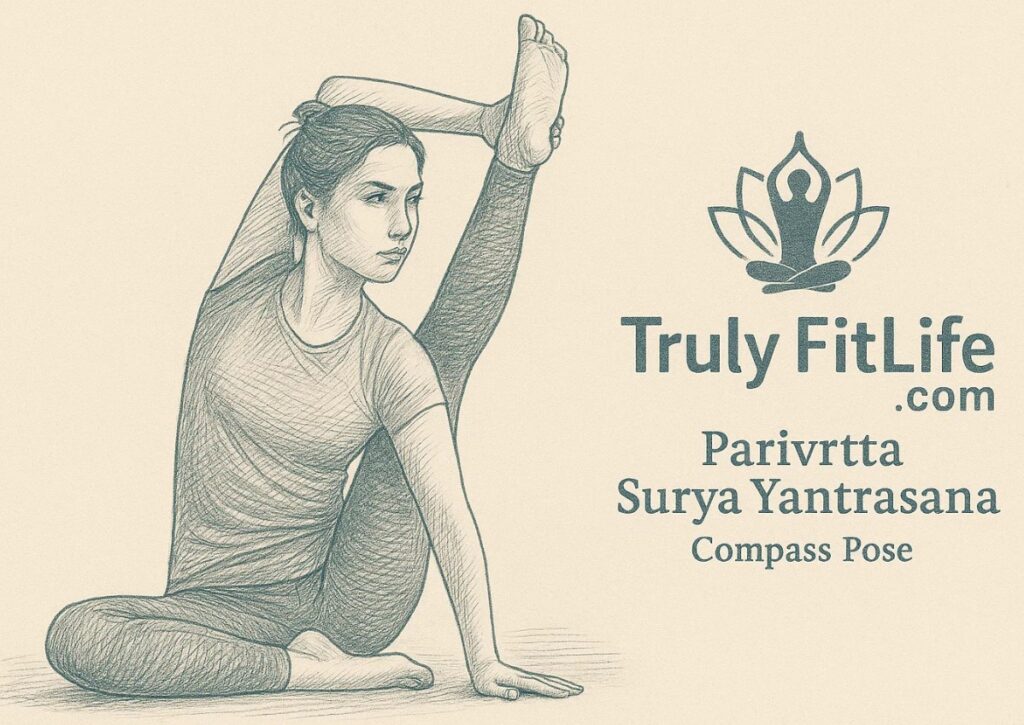
Parivrtta Surya Yantrasana – Compass Pose is an advanced yoga posture that challenges flexibility, balance, and awareness. The Sanskrit name breaks down as follows: Parivrtta means “revolved” or “twisted,” Surya means “sun,” and Yantra means “instrument” or “device.” When performed, the body resembles the needle of a compass pointing upward, symbolizing clarity, direction, and focus.
This asana is a deep hip opener and side body stretch that requires flexibility in the hamstrings, shoulders, and spine. Practicing Compass Pose regularly builds patience, resilience, and inner strength.
2. How to Practice Parivrtta Surya Yantrasana – Step-by-Step Guide
To perform Parivrtta Surya Yantrasana – Compass Pose safely:
- Begin in a comfortable seated position (Dandasana – Staff Pose).
- Bend your right knee and bring the sole of your right foot close to the left inner thigh.
- Lift your right leg with your right arm, bringing the knee close to the shoulder.
- Thread your right arm under the right thigh and place your right hand on the floor.
- Use your left hand to grasp the outside of your right foot.
- Inhale and extend the right leg upward, opening it diagonally.
- Rotate your torso slightly left, aligning shoulders.
- Keep your gaze upward or forward for balance.
- Hold for 20–40 seconds, breathing deeply.
- Slowly release and repeat on the other side.
👉 Tip: Use a strap around the lifted foot if flexibility is limited.
3. Benefits of Parivrtta Surya Yantrasana – Compass Pose
3.1 Physical Benefits
- Stretches hamstrings, hips, groin, and side body.
- Opens shoulders and improves spinal mobility.
- Strengthens core and improves posture.
- Enhances overall body coordination.
3.2 Mental & Emotional Benefits
- Develops focus and concentration.
- Builds patience through deep stretching.
- Helps release stored tension and stress.
3.3 Spiritual Benefits
- Activates Manipura (Solar Plexus Chakra) and Anahata (Heart Chakra).
- Symbolizes clarity of direction, aligning with life goals.
- Encourages pratyahara (withdrawal of senses) and dharana (concentration).
4. Anatomy and Muscles Engaged in Parivrtta Surya Yantrasana
This pose engages and stretches:
- Hamstrings & hip flexors – deep stretch.
- Obliques & intercostal muscles – side body engagement.
- Deltoids & rotator cuff – shoulder flexibility.
- Abdominals – core stability.
- Spinal extensors – maintaining upright posture.
5. Contraindications & Safety Precautions
Avoid or modify Parivrtta Surya Yantrasana – Compass Pose if you have:
- Severe hamstring or hip injuries.
- Chronic lower back pain.
- Shoulder stiffness or rotator cuff injuries.
Safety Tips:
- Warm up thoroughly before attempting.
- Use props to reduce strain.
- Avoid forcing the leg upward—progress gradually.
6. Variations and Modifications of Parivrtta Surya Yantrasana – Compass Pose
- Beginner Variation: Use a yoga strap around the lifted foot.
- Intermediate Variation: Keep the lifted leg bent slightly.
- Advanced Variation: Perform Compass Pose with one arm behind the back for an additional twist.
7. Preparatory and Counter Poses
Preparatory Poses:
- Dandasana (Staff Pose)
- Janu Sirsasana (Head-to-Knee Pose)
- Parighasana (Gate Pose)
Counter Poses:
- Sukhasana (Easy Pose with Side Stretch)
- Paschimottanasana (Seated Forward Bend)
- Balasana (Child’s Pose)
8. Parivrtta Surya Yantrasana in Yoga Philosophy and Tradition
In yoga philosophy, Compass Pose represents clarity of direction, much like a compass guiding travelers. It reminds practitioners of the importance of inner guidance and mindfulness.
This pose also connects to the sun energy (Surya), symbolizing vitality, focus, and awareness. It teaches balance between strength and surrender.
9. Common Mistakes to Avoid in Parivrtta Surya Yantrasana – Compass Pose
- Forcing the hamstrings without warm-up.
- Rounding the spine instead of elongating.
- Gripping the foot too tightly, creating shoulder strain.
- Holding breath instead of breathing steadily.
10. Final Thoughts
Parivrtta Surya Yantrasana – Compass Pose is a powerful asana that requires patience, practice, and flexibility. It not only strengthens the body but also symbolizes finding direction, balance, and clarity in life.
With regular practice and mindful alignment, Compass Pose becomes a gateway to deeper self-awareness and inner stability.
🧘 Related Yoga Poses You May Like
- ➤ Utthita Hasta Padangusthasana – Extended Hand-to-Big-Toe Pose
- ➤ Ardha Chandrasana – Half Moon Pose for Balance and Energy
- ➤ Utthita Parshvakonasana – Extended Side Angle Pose Complete Guide
- ➤ Parivrtta Trikonasana – Revolved Triangle Pose Complete Guide
- ➤ Pigeon Pose (Chair Yoga)
- ➤ Hamstring Stretch (Chair Yoga)