Table of Contents
- Introduction to Sucirandhrasana – Eye of the Needle Pose
- How to Practice Sucirandhrasana – Step-by-Step Guide
- Benefits of Sucirandhrasana – Eye of the Needle Pose
- Physical Benefits
- Mental & Emotional Benefits
- Spiritual Benefits
- Anatomy and Muscles Engaged in Sucirandhrasana
- Contraindications & Safety Precautions
- Variations and Modifications of Sucirandhrasana – Eye of the Needle Pose
- Preparatory and Counter Poses
- Sucirandhrasana in Yoga Philosophy and Tradition
- Common Mistakes to Avoid in Sucirandhrasana
- Final Thoughts
1. Introduction to Sucirandhrasana – Eye of the Needle Pose
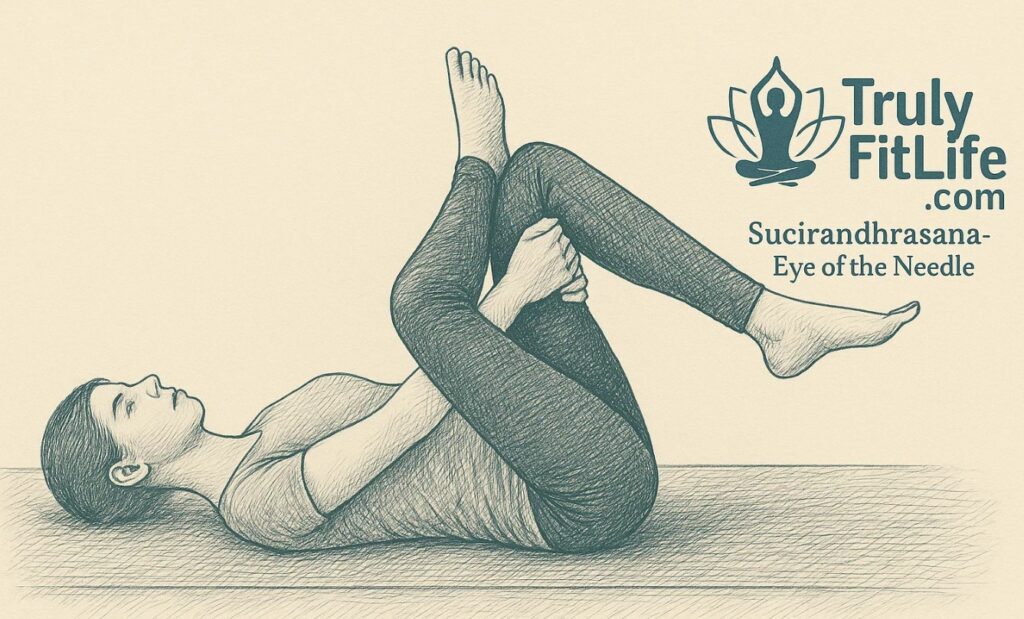
Sucirandhrasana – Eye of the Needle Pose is a gentle supine hip opener that provides relief for tight hips, glutes, and lower back. The Sanskrit term Sucirandhra translates to “needle’s eye,” describing the threading action of one leg through the other, resembling a needle passing through an opening.
This pose is highly therapeutic, particularly for people with sciatica, lower back stiffness, or hip tightness. It is also commonly practiced in Restorative Yoga, Yin Yoga, and therapeutic yoga sessions due to its calming and accessible nature.
2. How to Practice Sucirandhrasana – Step-by-Step Guide
To perform Sucirandhrasana – Eye of the Needle Pose safely:
- Begin lying flat on your back in Supta Tadasana (Reclined Mountain Pose).
- Bend your knees and place both feet flat on the floor.
- Cross your right ankle over the left thigh, just above the knee, forming a figure-four shape.
- Inhale and thread your right arm through the space between the legs (the “eye of the needle”).
- Clasp your hands behind the left thigh or shin.
- Exhale and gently draw the left leg toward your chest while keeping shoulders relaxed.
- Keep both feet active and flexed to protect the knees.
- Hold the pose for 30–60 seconds, breathing deeply.
- Release gently and repeat on the other side.
👉 Tip: If reaching the thigh is difficult, use a yoga strap or towel.
3. Benefits of Sucirandhrasana – Eye of the Needle Pose
3.1 Physical Benefits
- Stretches hips, glutes, and piriformis muscles.
- Relieves lower back pain and tension.
- Improves hip joint mobility.
- Alleviates discomfort from sciatica.
- Prepares the body for deeper hip-opening postures.
3.2 Mental & Emotional Benefits
- Reduces stress and calms the mind.
- Encourages mindful breathing and introspection.
- Provides a restorative, meditative effect.
3.3 Spiritual Benefits
- Activates the Muladhara (Root Chakra) for grounding.
- Encourages stillness and surrender.
- Enhances pranic flow in lower chakras, improving stability.
4. Anatomy and Muscles Engaged in Sucirandhrasana
This posture primarily engages:
- Gluteus maximus & piriformis – deep stretch.
- Hip flexors & adductors – gentle opening.
- Lower back muscles – release of tension.
- Hamstrings – mild stretch on the extended leg.
5. Contraindications & Safety Precautions
Avoid or modify Sucirandhrasana – Eye of the Needle Pose if you have:
- Knee injuries or surgery.
- Severe hip or sacroiliac joint issues.
- Pregnancy (modify with props).
Safety Tips:
- Avoid pulling too hard—let the stretch be gentle.
- Keep both feet flexed to protect the knees.
- Use props if mobility is limited.
6. Variations and Modifications of Sucirandhrasana – Eye of the Needle Pose
- Beginner Variation: Keep the bottom foot on the mat instead of lifting it.
- Advanced Variation: Draw the shin closer to the chest for a deeper stretch.
- Supported Variation: Use a strap to hold the thigh or shin.
- Wall Variation: Perform against a wall with feet pressed for support.
7. Preparatory and Counter Poses
Preparatory Poses:
- Supta Baddha Konasana (Reclined Bound Angle Pose)
- Apanasana (Knees-to-Chest Pose)
- Supta Padangusthasana (Reclined Big Toe Pose)
Counter Poses:
- Savasana (Corpse Pose)
- Setu Bandhasana (Bridge Pose)
- Supta Matsyendrasana (Reclined Spinal Twist)
8. Sucirandhrasana in Yoga Philosophy and Tradition
In yoga philosophy, Sucirandhrasana represents the ability to find openness within boundaries. The “needle’s eye” is symbolic of narrowing focus while creating space internally.
It is often practiced in Restorative Yoga and Yin Yoga sessions for its calming, grounding effects, aligning with the yogic principles of sukha (ease) and sthira (steadiness).
9. Common Mistakes to Avoid in Sucirandhrasana
- Pulling the leg forcefully, straining the knee.
- Letting the lower back arch excessively.
- Dropping shoulders off the mat instead of relaxing them.
- Forgetting to flex the feet, causing knee discomfort.
10. Final Thoughts
Sucirandhrasana – Eye of the Needle Pose is a gentle, restorative yoga asana that provides immense relief for tight hips and lower back pain. It is simple yet powerful, making it suitable for beginners, seniors, and anyone seeking stress relief and flexibility.
This pose is an excellent addition to evening or restorative yoga routines, preparing both body and mind for deep relaxation.
🧘 Related Yoga Poses You May Like
- ➤ Ananda Balasana – Happy Baby Pose: Steps, Benefits, and Relaxation Guide
- ➤ Baddha Konasana – Bound Angle Pose: A Complete Guide for Flexibility & Relaxation
- ➤ Supta Baddha Konasana – Reclined Bound Angle Pose: Steps, Benefits, and Relaxation Guide
- ➤ Pigeon Pose (Chair Yoga)
- ➤ Supta Matsyendrasana – Reclining Spinal Twist: Steps, Benefits, and Relaxation Guide
- ➤ Gomukhasana – Cow Face Pose