
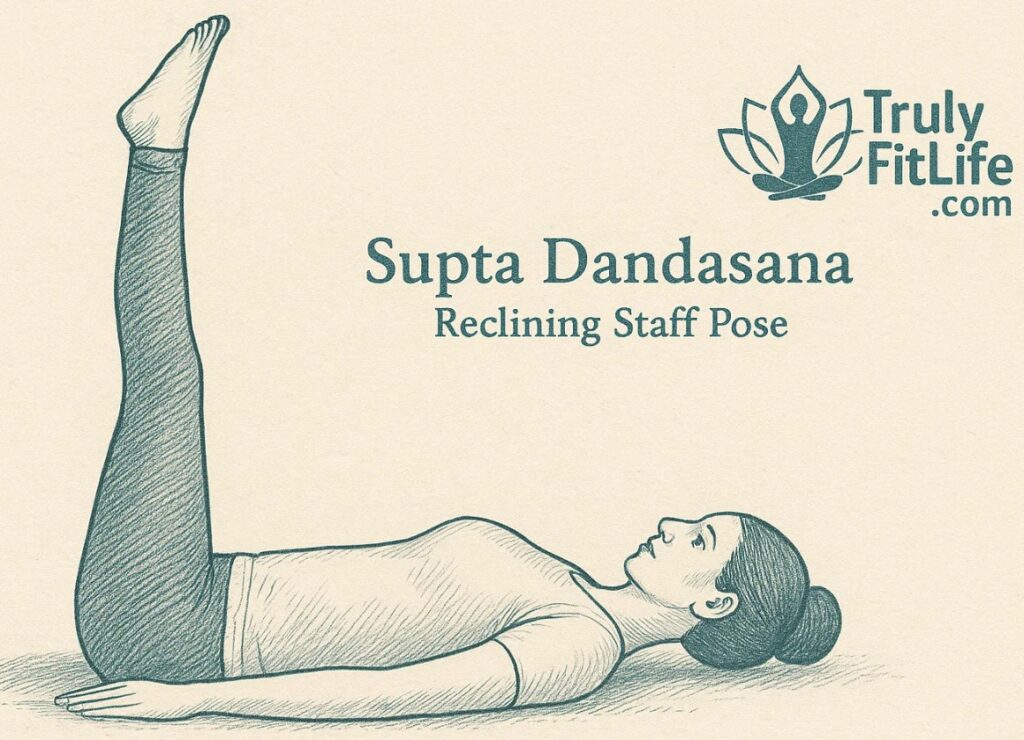
Supta Dandasana – Reclining Staff Pose is a grounding yoga posture that extends the benefits of Dandasana (Staff Pose) into a reclined position. This asana emphasizes spinal alignment, leg activation, and mindful breathing. It is often practiced in restorative or alignment-based yoga traditions to strengthen the legs, lengthen the spine, and cultivate awareness.
Though it may appear simple, Supta Dandasana requires steady focus and precise alignment to unlock its full benefits. It is highly suitable for practitioners who want to improve posture, release back tension, and practice mindful relaxation.
🗂️ Table of Contents
- What is Supta Dandasana?
- Step-by-Step Guide to Supta Dandasana – Reclining Staff Pose
- Benefits of Supta Dandasana – Reclining Staff Pose
- Muscles and Joints Engaged
- Breathing, Drishti, and Chakras
- Common Mistakes and How to Correct Them
- Variations and Modifications
- Contraindications and Safety Tips
- Practice Suggestions and Sequences
- Related Yoga Poses
- Conclusion
1. What is Supta Dandasana?
The Sanskrit breakdown:
- Supta – reclining or lying down
- Danda – staff or stick
- Asana – posture
Thus, Supta Dandasana translates to Reclining Staff Pose. The name reflects both its shape and symbolic meaning: like a staff, the body is aligned straight and steady, representing inner discipline and strength.
2. Step-by-Step Guide to Supta Dandasana – Reclining Staff Pose
- Start on your back. Lie down flat on your yoga mat, legs extended, arms at sides.
- Engage the legs. Press thighs down, keep heels active, and point toes upward.
- Align the spine. Lengthen lower back and keep the chest open.
- Activate arms. Place palms on the floor beside hips, pressing lightly for grounding.
- Maintain gaze. Keep eyes closed or softly focus upward.
- Hold the posture. Stay for 30–60 seconds, breathing slowly and evenly.
- Release gently. Relax arms and legs fully, transitioning into Savasana if needed.
3. Benefits of Supta Dandasana – Reclining Staff Pose
Regular practice of Supta Dandasana – Reclining Staff Pose offers:
- ✅ Strengthens legs and ankles – activates quadriceps, calves, and ankles.
- ✅ Improves spinal alignment – encourages posture awareness.
- ✅ Relieves back tension – stretches lower back and hips.
- ✅ Enhances breathing – opens chest for deeper inhalations.
- ✅ Calms the mind – promotes grounding and relaxation.
- ✅ Prepares for meditation – trains focus and steadiness.
👉 According to Yoga Journal, Supta variations like this one are excellent for developing awareness of body alignment and cultivating stillness.
4. Muscles and Joints Engaged
- Quadriceps and hamstrings
- Calves and ankle stabilizers
- Spinal erectors
- Glutes and hip stabilizers
- Shoulders and arms (for grounding)
5. Breathing, Drishti, and Chakras
- Breathing: Inhale to expand chest, exhale to relax shoulders.
- Drishti (gaze): Eyes closed or gentle focus upward.
- Chakras: Activates Muladhara Chakra (Root) for grounding and Ajna Chakra (Third Eye) for awareness.
6. Common Mistakes and How to Correct Them
❌ Collapsing lower back → ✅ Lengthen tailbone and engage core.
❌ Legs inactive → ✅ Keep heels pressing away and thighs firm.
❌ Shoulders tense → ✅ Relax shoulders, broaden collarbones.
❌ Holding breath → ✅ Maintain steady, natural breathing.
7. Variations and Modifications
- Beginner: Place a folded blanket under head or knees.
- Intermediate: Extend arms overhead to deepen stretch.
- Advanced: Engage in breath retention (Kumbhaka) for meditative effect.
- Therapeutic: Use a bolster under spine for support.
8. Contraindications and Safety Tips
Avoid or modify Supta Dandasana if you have:
- Recent back or spinal injuries
- Severe hip or hamstring pain
- Breathing difficulties (practice with support)
Always enter and exit the pose slowly to protect the lower back.
9. Practice Suggestions and Sequences
- Best practiced at the beginning or end of a yoga session.
- Hold for 30–60 seconds, repeat 2–3 rounds.
- Combine with Dandasana, Supta Padangusthasana, and Savasana.
- Great for cooling down after standing sequences.
10. Related Yoga Poses
- Dandasana – Staff Pose
- Supta Padangusthasana – Reclining Hand-to-Big-Toe Pose
- Paschimottanasana – Seated Forward Bend
- Savasana – Corpse Pose
(Link internally to your site’s related posts.)
11. Conclusion
Supta Dandasana – Reclining Staff Pose is a simple yet powerful asana for alignment, awareness, and relaxation. It strengthens the legs, lengthens the spine, and cultivates calmness, making it an excellent posture for both beginners and advanced practitioners.
By practicing with mindfulness, this pose teaches the art of steadiness, stillness, and grounding, helping prepare both body and mind for deeper yoga and meditation practices.


