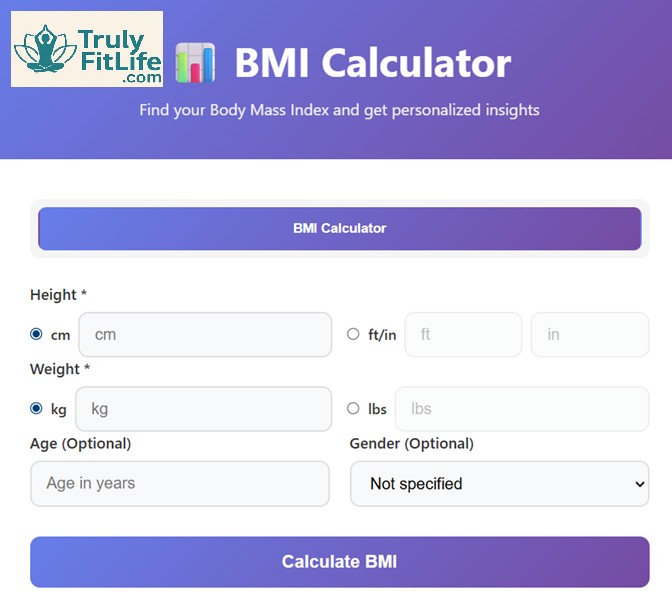
📊 Enter your details to calculate your calories
✅ How This Calorie Calculator Works
This Calorie Calculator estimates your daily calorie needs using scientifically accepted metabolic formulas that are widely used in nutrition and fitness research.
Step 1: Basal Metabolic Rate (BMR)
First, the calculator estimates your Basal Metabolic Rate (BMR) — the number of calories your body needs to carry out essential functions such as:
- Breathing
- Blood circulation
- Digestion
- Brain and organ function
Even if you stayed in bed all day, your body would still burn calories to survive.
Step 2: Activity Level & TDEE
Next, your BMR is multiplied by your activity level to estimate your
Total Daily Energy Expenditure (TDEE).
This reflects calories burned from:
- Daily movements
- Work routine
- Exercise, yoga, or workouts
Step 3: Goal-Based Calorie Targets
Finally, the calculator provides calorie targets for:
- Weight loss
- Weight maintenance
- Healthy weight gain
These values are practical starting points that help you plan meals and fitness routines more effectively.
✅ How Many Calories Do You Need Per Day?
There is no single calorie number that works for everyone.
Your daily calorie needs depend on several personal factors:
- Age
- Gender
- Height & body weight
- Muscle mass
- Activity level
- Lifestyle (sedentary vs active)
For example:
Two people of the same weight may need very different calories if one is active and the other is sedentary.
As you lose or gain weight, your calorie needs also change. That’s why using a personalized calorie calculator is far more effective than following generic calorie charts.
👉 The result you get here is an estimate, but it is accurate enough for most people to guide daily eating and fitness decisions.
✅ Using Your Calorie Results for Weight Loss, Maintenance or Gain
🔻 Calories for Weight Loss
For safe and sustainable weight loss:
- Aim for a moderate calorie deficit of about 300–500 calories per day
- Combine calorie control with light exercise, yoga, or walking
Avoid very low-calorie diets, as they can:
- Slow down metabolism
- Cause fatigue and nutrient deficiencies
- Be difficult to maintain long term
Slow, steady progress gives better results.
🔸 Calories for Weight Maintenance
If your goal is to maintain your current weight:
- Consume calories close to your maintenance (TDEE) number
- Focus on consistent eating habits and regular movement
This approach supports:
- Stable energy levels
- Better performance during workouts
- Long-term health balance
🔺 Calories for Healthy Weight or Muscle Gain
For healthy weight gain:
- Add 300–500 calories above maintenance
- Focus on nutrient-dense foods, not junk calories
Pair higher calorie intake with:
- Strength training or resistance exercises
- Proper recovery and sleep
This helps ensure weight gain comes mostly from muscle rather than excess fat.
✅ Calorie Calculator – Frequently Asked Questions
❓ Is this calorie calculator accurate?
This calculator provides a science-based estimate, not a medical diagnosis.
It is accurate enough for most healthy adults and widely used as a starting point for fitness and nutrition planning.
❓ Should I eat exactly the number shown?
Not necessarily. Use the result as a guideline, then monitor:
- Weight trend over 2–3 weeks
- Energy levels
- Hunger and recovery
Small adjustments are normal and expected.
❓ How often should I recalculate my calories?
You should recalculate if:
- Your weight changes noticeably
- Your activity level changes
- Every 2–3 months during a fitness journey
❓ Is calorie counting required forever?
No. Many people use calorie tracking temporarily to:
- Understand portion sizes
- Build awareness of food choices
Once habits improve, you may rely more on balanced eating and mindful movement.
❓ Can I use this calorie calculator with yoga?
Yes. Yoga is an excellent complement to calorie awareness.
It supports movement, mindfulness, flexibility, and stress control, all of which help maintain a healthy weight.
✅ What Is BMI (Body Mass Index)?
BMI (Body Mass Index) is a simple measure that helps estimate whether a person’s body weight is healthy for their height. It is commonly used as a general health indicator to categorize weight status in adults.
BMI does not measure body fat directly, but it provides a quick and easy way to understand if body weight may fall within a healthy range.
✅ How Is BMI Calculated?
BMI is calculated using this formula:
BMI = weight (kg) ÷ height² (m²)
For example, a person who weighs 70 kg and is 1.7 m tall would have a BMI of 24.2.
Many people prefer using a BMI calculator to get instant and accurate results.
✅ BMI Categories (Adults)
The standard BMI categories for adults are:
- Underweight: Below 18.5
- Normal weight: 18.5 – 24.9
- Overweight: 25 – 29.9
- Obese: 30 and above
These categories are widely used as a reference for adult health assessments.
✅ Why Is BMI Important?
BMI helps to:
- Identify weight-related health risks
- Support weight management decisions
- Set realistic fitness and calorie goals
- Track long-term weight trends
When used along with a calorie calculator, BMI gives a clearer picture of overall body status.
✅ BMI and Calorie Intake
BMI and calorie intake are closely connected:
- Higher BMI usually signals a need for calorie control
- Lower BMI may indicate a need for increased calorie intake
- Normal BMI often aligns with maintenance calorie needs
Using both tools together helps create a balanced and practical approach to health.
✅ Important Note About BMI
BMI is a general guideline, not a medical diagnosis.
It may not accurately reflect body composition in:
- Athletes with high muscle mass
- Elderly individuals
- People with different body builds
Always use BMI as a starting point and consider lifestyle factors like activity level, strength, and overall well-being.
✅ Next Steps for a Healthier Lifestyle
Knowing your daily calorie needs is just the first step, not the final goal.
For long-term health and sustainable results, focus on:
✅ Consistent movement (yoga, walking, home workouts)
✅ Balanced meals with whole, minimally processed foods
✅ Adequate hydration
✅ Quality sleep and stress management
✅ Realistic goals you can maintain
Instead of chasing perfection, aim for small daily improvements.
👉 Use this Calorie Calculator as a helpful guide — and build habits that support your health in real life.