Soaked walnuts are a popular way to enjoy this nutrient-rich nut. Many people soak walnuts overnight because they become softer and easier to chew. Walnuts provide healthy fats, plant-based omega-3 fatty acids, fiber, minerals, and antioxidant compounds.
But are soaked walnuts healthier than raw walnuts? Do they improve digestion, brain function, or nutrient absorption? And how many should you eat daily?
In this guide, we explain the potential benefits of soaked walnuts, their nutritional value, how to prepare them safely, practical serving suggestions, possible side effects, and who should be cautious.
Important: Most of the established nutritional benefits come from walnuts themselves. There is limited scientific evidence that soaking significantly improves their nutritional value or health effects.
Table of Contents
- What Are Soaked Walnuts?
- Nutrition in Walnuts
- Potential Health Benefits of Soaked Walnuts
- Does Soaking Walnuts Make Them Healthier?
- Soaked Walnuts vs. Raw Walnuts
- How Many Soaked Walnuts Should You Eat Daily?
- Practical Serving Suggestions
- How to Soak Walnuts Safely
- Possible Side Effects of Soaked Walnuts
- Who Can Eat Soaked Walnuts?
- Who Should Avoid or Limit Walnuts?
- Can Children Eat Soaked Walnuts?
- Frequently Asked Questions
- Final Thoughts
1. What Are Soaked Walnuts?
Soaked walnuts are shelled walnut kernels that have been placed in water for several hours, commonly overnight.
Soaking softens the walnuts and changes their texture. Some people prefer this because softened walnuts may be easier to chew.
Walnuts are naturally rich in unsaturated fats, including alpha-linolenic acid (ALA), a plant-based omega-3 fatty acid. They also contain fiber, protein, magnesium, and other nutrients.
Soaking is optional. Raw walnuts provide many of the same nutrients and can be included in a balanced diet without soaking.
2. Nutrition in Walnuts
Walnuts are nutrient-dense, meaning they provide several nutrients in a relatively small serving.
Approximate Nutrition in 28 Grams of Walnuts
A 28-gram serving is approximately one ounce, or around 12–14 walnut halves.
- Calories: 185 kcal
- Protein: 4.3 g
- Total fat: 18.5 g
- Dietary fiber: 1.9 g
- Omega-3 ALA: 2.57 g
- Omega-6 fatty acids: 10.8 g
- Magnesium: 44.8 mg
- Potassium: 125 mg
- Calcium: 27.8 mg
Values are approximate and can vary depending on walnut size and variety.
Walnuts contain a high proportion of unsaturated fats. Although these are generally considered beneficial fats, walnuts are still calorie-dense, so portion size matters.
3. Potential Health Benefits of Soaked Walnuts
The following benefits are primarily associated with eating walnuts as part of a balanced diet. They should not be considered guaranteed effects of soaking.
1. May Support Heart Health
Walnuts contain polyunsaturated fats, including omega-3 ALA. Replacing some foods high in saturated fat with walnuts may help support a heart-healthy eating pattern.
Research on walnut consumption has found improvements in certain blood lipid measurements, including LDL cholesterol, in some study populations.
However, walnuts are not a replacement for prescribed cholesterol medication or medical care.
2. Provides Plant-Based Omega-3 Fatty Acids
Walnuts are one of the better-known plant sources of alpha-linolenic acid (ALA).
ALA is an essential fatty acid, which means the body cannot produce it in sufficient amounts and must obtain it from food.
The body can convert some ALA into the omega-3 fatty acids EPA and DHA, but this conversion is limited. Walnuts therefore contribute to omega-3 intake but do not provide the same amounts of EPA and DHA found in oily fish.
3. Supports Healthy Digestion
Walnuts contain dietary fiber, which contributes to normal digestive function and bowel regularity.
Including fiber-rich foods in your diet may help support a healthy digestive system. However, eating a large amount of walnuts suddenly may cause bloating or discomfort in some people.
If you are not used to eating nuts or fiber-rich foods, start with a small portion.
4. Provides Nutrients Important for Brain Function
Walnuts contain ALA, polyphenols, and other nutrients involved in normal body functions.
These nutrients are relevant to overall health, including brain health. However, evidence that eating soaked walnuts directly improves memory, intelligence, or concentration is limited.
It is more accurate to describe walnuts as a nutritious food that can form part of a balanced diet rather than a treatment for memory problems.
5. May Help You Feel Full
Walnuts contain fat, protein, and fiber. These nutrients can contribute to satiety, or the feeling of fullness after eating.
A small serving of walnuts may make a snack more satisfying, especially when eaten with fruit or yogurt.
Walnuts do not automatically cause weight loss. Because they are calorie-dense, large portions can add substantial calories to your diet.
6. Contains Antioxidant Compounds
Walnuts contain plant compounds, including polyphenols, that have antioxidant activity.
Antioxidants help protect cells from oxidative damage as part of the body’s normal protective systems.
Eating walnuts can contribute to an overall diet rich in plant foods, but they should not be described as detoxifying the body or preventing disease on their own.
7. Contributes to Blood Sugar-Friendly Meal Choices
Walnuts contain very little natural sugar and provide fat, fiber, and protein.
When included in a balanced meal or snack, they may help make the meal more satisfying. Some research has examined walnut consumption in relation to blood sugar control and metabolic health.
However, walnuts do not cure diabetes or replace prescribed treatment. People with diabetes should consider their overall meal plan and individual nutrition needs.
8. Provides Minerals That Support Normal Body Functions
Walnuts provide magnesium, potassium, and smaller amounts of other minerals.
Magnesium contributes to normal muscle and nerve function, energy metabolism, and bone structure. Potassium is important for normal muscle function and fluid balance.
Walnuts can contribute to mineral intake, but they are not a complete source of all nutrients needed for bone or general health.
9. Can Be Part of a Balanced Eating Pattern
Walnuts can be added to meals that include fruits, vegetables, whole grains, legumes, and other nutrient-rich foods.
For example, adding a small portion of walnuts to oatmeal or yogurt can provide healthy fats and a different texture.
The overall quality and variety of your diet matter more than relying on one food for health benefits.
10. Offers a Convenient, Nutrient-Rich Snack
Walnuts are easy to portion and can be eaten at home or added to meals.
Soaking them is one preparation option, especially if you prefer a softer texture. Raw walnuts are also nutritious and convenient.
4. Does Soaking Walnuts Make Them Healthier?
Soaking walnuts is common, but claims about its benefits are sometimes exaggerated.
What Soaking May Do
- Softens the walnut kernels.
- Changes the texture and may make them easier to chew.
- Makes walnuts suitable for people who prefer softer nuts.
- Provides an alternative preparation method.
What Has Not Been Clearly Proven
There is not strong evidence that soaking walnuts:
- Dramatically increases nutrient absorption.
- Removes all antinutrients.
- Makes walnuts significantly healthier than raw walnuts.
- Activates special enzymes that provide major health benefits.
- Improves memory or prevents disease.
Walnuts contain naturally occurring compounds such as phytates. Soaking may affect some water-soluble compounds, but it should not be assumed to remove all phytates or meaningfully improve mineral absorption in everyday eating.
Bottom line: Soak walnuts if you enjoy their softer texture. You do not need to soak them to receive their nutritional benefits.
5. Soaked Walnuts vs. Raw Walnuts
Both soaked and raw walnuts can be part of a healthy diet.
Soaked Walnuts
- Softer texture.
- May be easier to chew for some people.
- Require preparation and safe storage.
- Should be drained and eaten promptly after soaking.
Raw Walnuts
- Convenient and ready to eat.
- Retain their natural texture.
- Do not require soaking or refrigeration before opening.
- Provide similar core nutrients.
There is no established reason that everyone should choose soaked walnuts over raw walnuts. Personal preference, convenience, and safe food handling are reasonable factors in deciding how to eat them.
6. How Many Soaked Walnuts Should You Eat Daily?
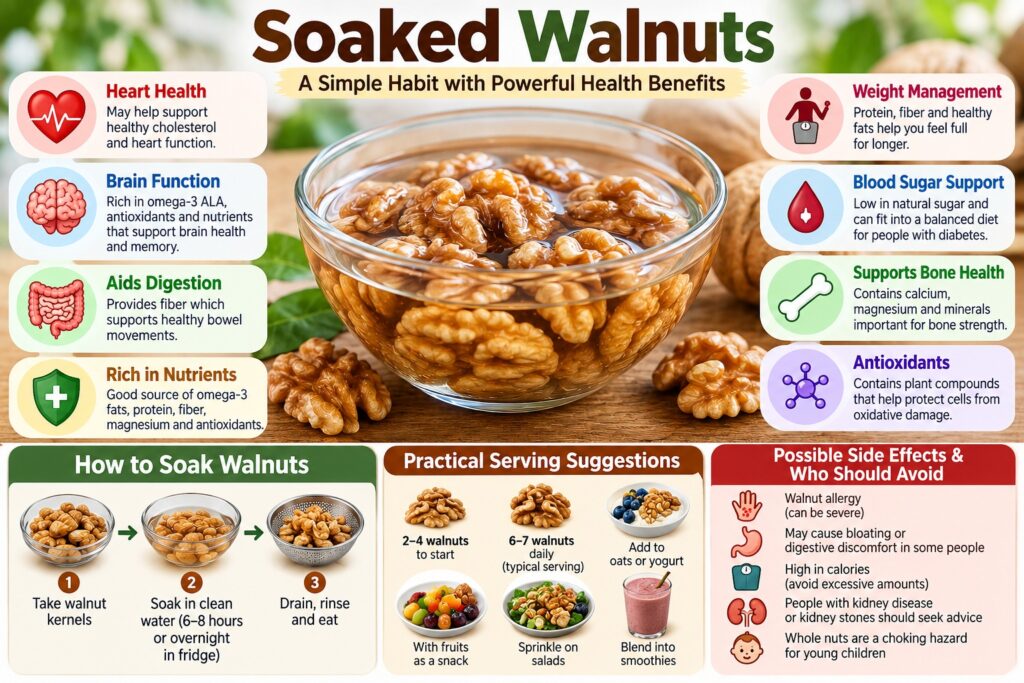
A practical serving for many adults is around 28 grams of walnuts, which is approximately:
- 12–14 walnut halves, or
- 6–7 whole walnuts, depending on size.
If you are new to eating walnuts, start with 2–4 whole walnuts and see how your body responds.
The appropriate amount depends on your overall calorie needs, dietary pattern, and any medical advice you have received.
Walnuts are calorie-dense, so eating more is not necessarily better.
7. Practical Serving Suggestions
Here are simple ways to include soaked walnuts in your daily diet.
At Breakfast
- Add chopped walnuts to oatmeal or porridge.
- Mix them into plain yogurt with fruit.
- Sprinkle a few pieces over whole-grain cereal.
As a Snack
- Eat a small portion with an apple, banana, or other fruit.
- Combine walnuts with other unsalted nuts in a measured serving.
- Have them alongside yogurt for a more filling snack.
With Lunch or Dinner
- Sprinkle chopped walnuts over salads.
- Add them to cooked vegetables.
- Use finely chopped walnuts as a topping for grain or lentil dishes.
In Smoothies
Blend a small portion of walnuts into a smoothie with fruit, milk, or yogurt. Keep the serving moderate because walnuts add calories.
A Simple Daily Routine
If you enjoy soaked walnuts, you could try this routine:
- Start with 2–4 whole walnuts.
- Soak them safely in the refrigerator.
- Drain and rinse them before eating.
- Add them to breakfast or have them as a snack.
- Adjust the portion according to your appetite and dietary needs.
There is no proven best time of day to eat walnuts. Choose a time that fits your routine.
8. How to Soak Walnuts Safely
Soaking nuts in water creates a moist environment, so safe preparation and storage are important.
Steps to Prepare Soaked Walnuts
- Take the required number of shelled walnut kernels.
- Place them in a clean bowl or covered container.
- Add enough clean drinking water to cover the walnuts.
- Cover the container and place it in the refrigerator.
- Soak for approximately 6–8 hours or overnight.
- Drain the water.
- Rinse the walnuts with clean drinking water.
- Eat them promptly.
Important Food Safety Tips
- Use clean hands, utensils, and containers.
- Prefer refrigeration rather than leaving walnuts soaking at room temperature for extended periods.
- Do not eat walnuts that smell sour, look moldy, or have an unusual texture.
- Avoid storing soaked walnuts for long periods.
- Do not assume that soaking water has health benefits. Drain it and discard it.
If you prefer not to soak walnuts, eating them raw is a convenient alternative.
9. Possible Side Effects of Soaked Walnuts
Walnuts are safe for most people when eaten in ordinary food portions, but some people may experience problems.
1. Walnut Allergy
Walnut allergy can cause symptoms ranging from itching or hives to serious allergic reactions, including anaphylaxis.
Soaking does not remove walnut allergens.
Anyone with a known walnut allergy should avoid walnuts and follow their healthcare professional’s advice.
2. Bloating or Digestive Discomfort
Some people may experience:
- Bloating
- Gas
- Abdominal discomfort
- Loose stools
This may be more likely when eating large portions or when nuts are not usually part of the diet.
Try a smaller serving if you experience mild discomfort. Avoid walnuts if they consistently trigger symptoms or if a healthcare professional has advised you to do so.
3. High Calorie Content
Walnuts are nutritious but energy-dense. Eating large quantities in addition to your usual meals can increase daily calorie intake.
For weight management, measure your portion rather than eating directly from a large container.
4. Food Safety Concerns During Soaking
Leaving walnuts soaking for too long at room temperature may create conditions that allow microorganisms to grow.
Use clean equipment, refrigerate while soaking, and eat the walnuts promptly after draining and rinsing.
5. Individual Dietary Restrictions
People with certain kidney conditions or medically prescribed diets may need to monitor nutrients such as potassium or phosphorus.
Walnuts also contain naturally occurring oxalates. People with a history of particular types of kidney stones should ask their clinician or dietitian whether walnuts fit their individual diet.
Do not eliminate nutritious foods unnecessarily without considering your personal medical advice.
10. Who Can Eat Soaked Walnuts?
For most people without a walnut allergy or specific dietary restriction, walnuts can be included as part of a balanced diet.
Adults
Adults can enjoy raw or soaked walnuts in moderate portions.
Older Adults
Walnuts can provide healthy fats, fiber, and minerals. People who have difficulty chewing may prefer softened or finely chopped walnuts, provided they can swallow them safely.
People Following a Vegetarian Diet
Walnuts provide plant-based ALA omega-3 fatty acids and can contribute to a varied vegetarian diet.
People Managing Their Weight
A measured serving may be satisfying as a snack. However, portion control matters because walnuts contain many calories for their volume.
People With Diabetes
Walnuts contain little natural sugar and can fit into many diabetes-friendly meal plans. Individual portions should align with the person’s overall nutrition plan and medical advice.
11. Who Should Avoid or Limit Walnuts?
People With Walnut Allergy
Avoid walnuts if you have a confirmed walnut allergy. Soaking, rinsing, or cooking does not make them safe for someone with an allergy.
People With Certain Kidney Conditions
People following a kidney-specific diet may need individualized guidance about potassium, phosphorus, and other dietary factors.
People With a History of Kidney Stones
Some kidney stones are associated with dietary oxalate. If you have been advised to limit oxalate, ask your clinician or dietitian whether walnuts are appropriate for you.
People Who Experience Digestive Symptoms
If walnuts regularly cause bloating, abdominal discomfort, or other symptoms, reduce the amount or avoid them and seek medical advice if symptoms persist.
People Who Need to Manage Calorie Intake
Walnuts do not need to be avoided, but portion size may matter for people following a calorie-controlled eating plan.
12. Can Children Eat Soaked Walnuts?
Walnuts contain nutrients that can contribute to a child’s varied diet, but the form and serving size are important.
Whole nuts can be a choking hazard for young children. Do not give whole walnuts or large hard pieces to toddlers or young children.
Depending on the child’s age and ability to eat safely, walnuts may be offered in a finely ground form or as a smooth nut paste mixed into suitable foods. Follow age-appropriate feeding guidance from your pediatrician.
If a child has a known nut allergy, do not give walnuts unless their healthcare professional has specifically advised otherwise.
13. Frequently Asked Questions
Are soaked walnuts better than raw walnuts?
Not necessarily. Soaking softens walnuts, but there is limited evidence that it provides major nutritional advantages over eating them raw. Both forms provide nutrients such as unsaturated fats, ALA, fiber, and minerals.
How many soaked walnuts should I eat daily?
A common adult serving is around 28 grams, approximately 12–14 walnut halves or 6–7 whole walnuts, depending on size. Start with a smaller portion if you are not used to eating walnuts.
Can I eat soaked walnuts every day?
Many people can include a moderate portion of walnuts daily as part of a balanced diet. Consider allergies, calorie needs, digestive tolerance, and any medical dietary restrictions.
Should I drink the water used to soak walnuts?
There is no established health benefit that makes drinking walnut-soaking water necessary. Drain and discard the water, then rinse the walnuts before eating.
What is the best time to eat soaked walnuts?
There is no scientifically established best time. You can eat them at breakfast, as a snack, or with a meal.
Do soaked walnuts improve memory?
Walnuts contain nutrients relevant to overall health, including ALA and antioxidant compounds. However, strong evidence that soaked walnuts specifically improve memory or prevent cognitive decline is lacking.
Do soaked walnuts help with weight loss?
Walnuts contain fat, protein, and fiber, which may help you feel full. However, they are calorie-dense and do not independently cause weight loss. Portion size and the overall diet matter.
Can I soak walnuts overnight?
Yes. For safer preparation, soak them in a clean, covered container in the refrigerator rather than leaving them at room temperature overnight. Drain, rinse, and eat promptly.
Can I give soaked walnuts to a toddler?
Do not serve whole walnuts to toddlers because of choking risk. Ask your pediatrician about age-appropriate forms, such as finely ground walnuts or smooth nut paste, and consider allergy guidance.
14. Final Thoughts
Soaked walnuts are a convenient option if you prefer a softer texture, but soaking is not essential for good nutrition. Walnuts naturally provide unsaturated fats, plant-based omega-3 ALA, fiber, minerals, and antioxidant compounds.
For many adults, a moderate serving of around 28 grams can fit into a balanced diet. Enjoy walnuts with breakfast, fruit, yogurt, salads, or other meals, and avoid excessive portions.
If you soak walnuts, use clean water and containers, refrigerate them during soaking, drain and rinse them, and eat them promptly. People with walnut allergies should avoid them, while those with kidney-related dietary restrictions should seek individualized advice.
The key takeaway: Choose raw or soaked walnuts according to your preference, keep portions moderate, and treat them as one nutritious part of an overall balanced diet.
Medical Disclaimer: This article is for general educational purposes only and is not a substitute for professional medical or dietary advice. Consult a qualified healthcare professional for guidance about food allergies, kidney conditions, kidney stones, or other medical dietary restrictions.